New York Business Travel Guide: Luxury Hotels, Executive Transportation and Smart Planning
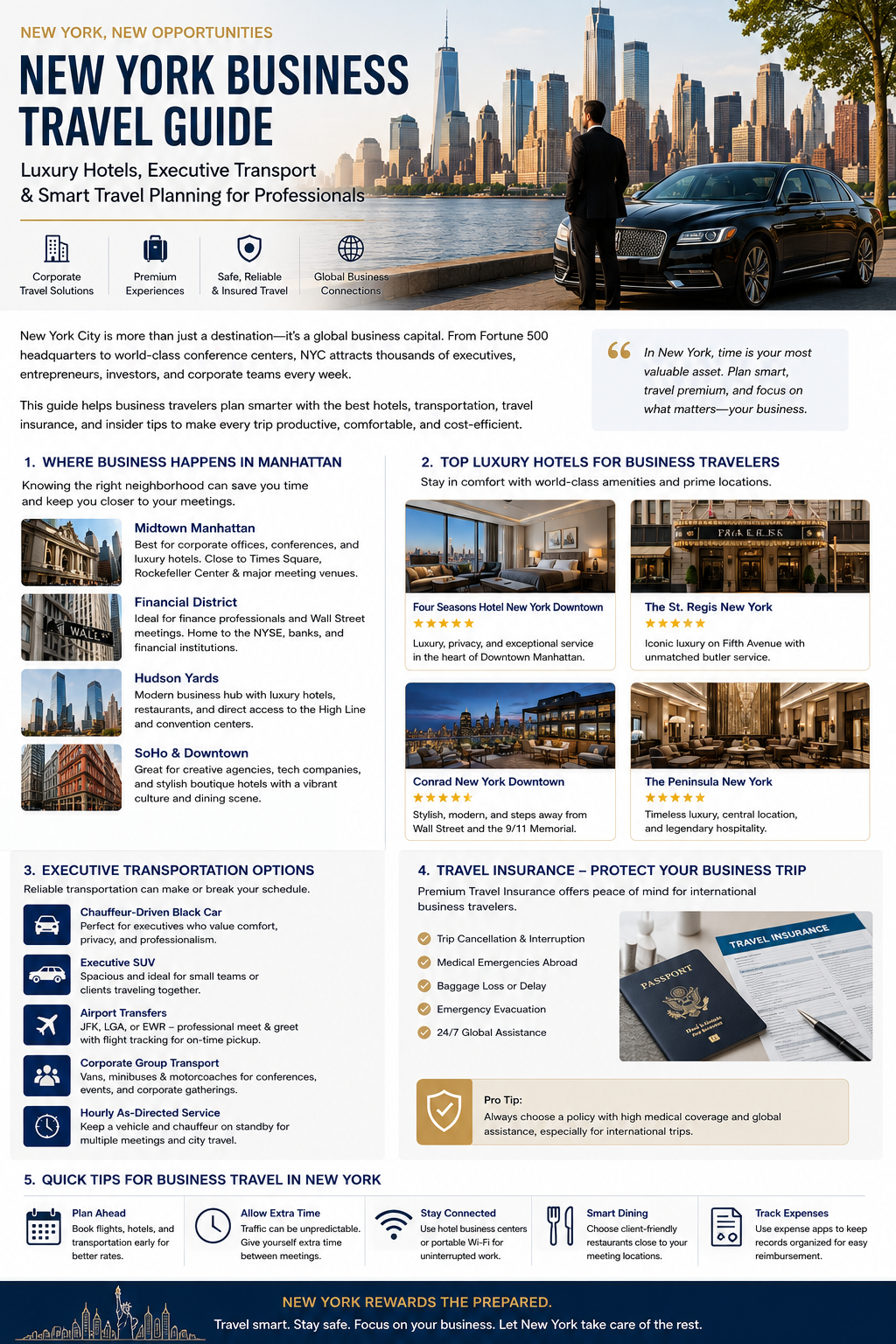
New York City is one of the world’s most active destinations for professionals, entrepreneurs, investors, corporate teams, and international business visitors. A successful business trip to the city is about more than finding a hotel and booking a flight. The right neighborhood, transportation, accommodation, insurance, and daily schedule can make a major difference.
For executives with meetings across Manhattan, time is especially valuable. A well-organized itinerary can reduce unnecessary travel and leave more time for clients, presentations, negotiations, and networking.
This guide explores practical ways to plan a comfortable and efficient business trip to New York, including where to stay, how to arrange executive transportation, and what to consider when choosing premium travel services.
New York as a Global Business Destination
New York has a unique position in the international business world.
The city attracts professionals working in:
- Finance and banking
- Technology
- Media and entertainment
- Consulting
- Real estate
- Fashion
- Law
- International trade
- Healthcare
- Advertising
- Investment
Many business travelers may have several appointments during a single visit. One meeting might take place in Midtown while another is downtown, followed by dinner with a client in another neighborhood.
This makes planning particularly important.
Rather than treating the entire city as one business district, travelers should identify where their meetings are located before choosing their hotel.
1. Pick Your Manhattan Base Carefully
Midtown Manhattan
Midtown is a strong option for professionals attending conferences or meeting companies located around the central business area.
Its location can also be useful for travelers who want convenient access to restaurants, hotels, offices, and transportation.
Financial District
Professionals visiting banks, investment firms, financial institutions, and companies around Wall Street may benefit from staying downtown.
Reducing the distance between the hotel and the first morning appointment can make the day easier.
Hudson Yards
Hudson Yards provides a modern business environment with offices, restaurants, retail, hotels, and event facilities.
It can be attractive to professionals whose meetings are concentrated on Manhattan’s west side.
SoHo and Lower Manhattan
Creative businesses, agencies, technology companies, and entrepreneurs may have meetings in downtown neighborhoods.
These areas can also provide a different atmosphere for informal client meetings and dinners.
2. Finding the Right Luxury Hotel
A luxury hotel can be attractive to executives, but the most expensive property is not automatically the best choice.
Business travelers should consider the practical features they actually need.
Look for:
- Reliable Wi-Fi
- Comfortable workspace
- Business services
- Meeting facilities
- Quiet rooms
- Convenient dining
- Fitness facilities
- 24-hour assistance
- Easy access to transportation
Location should remain one of the first considerations.
A hotel that saves 20 or 30 minutes on several daily journeys can sometimes provide more practical value than a property with additional luxury features.
For executives meeting clients at the hotel, conference rooms and private spaces can also be important.
3. Executive Transportation in New York
Transportation is one of the most important elements of corporate travel.
Public transportation can be highly useful, but some executives require private transportation because of tight schedules, luggage, privacy requirements, or multiple meetings.
Common executive transportation options include:
Chauffeur-Driven Cars
A professional chauffeur-driven sedan can be suitable for individual executives or small business groups.
It can provide a comfortable environment between meetings and eliminate the need to navigate unfamiliar streets.
Executive SUVs
An executive SUV can provide additional passenger and luggage space.
This can be useful when traveling with colleagues, clients, or presentation equipment.
Corporate Vans
Companies traveling as a group may consider larger vehicles.
Corporate vans can be useful for:
- Conferences
- Company events
- Airport transfers
- Team meetings
- Business tours
- Group dinners
Hourly Transportation
For executives with several appointments, hourly transportation can be worth considering.
Instead of booking separate rides for every destination, a vehicle and driver may remain available for the scheduled period, depending on the provider’s terms.
4. Planning Airport Transfers
New York’s major airports include JFK, LaGuardia, and Newark Liberty International Airport.
The best airport for a business traveler depends on the airline, flight route, hotel location, and meeting schedule.
Before booking an airport transfer, confirm:
- Flight number
- Arrival terminal
- Passenger count
- Luggage requirements
- Pickup location
- Hotel address
- Estimated travel time
- Provider’s waiting policy
International travelers should allow sufficient time for immigration, baggage collection, and customs procedures before scheduling onward transportation.
For important meetings, it is better to allow a reasonable buffer rather than planning a transfer around the minimum possible journey time.
5. Premium Travel Insurance for International Visitors
Business trips can involve significant prepaid expenses, especially when flights, hotels, conference tickets, and transportation are booked in advance.
Premium travel insurance may provide protection for certain covered situations, depending on the policy.
Potential areas of coverage can include:
- Medical emergencies
- Trip cancellation
- Trip interruption
- Travel delays
- Lost baggage
- Emergency assistance
Travelers should never assume that every policy provides the same protection.
Before purchasing insurance, review the policy’s coverage limits, exclusions, deductibles, eligibility requirements, and claims process.
International business travelers should also check whether their employer already provides travel coverage.
6. Luxury Executive Housing for Longer Stays
Not every corporate trip lasts two or three nights.
Executives may visit New York for several weeks because of:
- Corporate relocation
- Temporary projects
- Training programs
- Company launches
- Consulting assignments
- Long-term negotiations
For extended stays, luxury executive housing or furnished accommodation can sometimes be more practical than traditional hotel arrangements.
Depending on the property, longer-stay accommodation may provide:
- Separate living areas
- Kitchen facilities
- Workspace
- Laundry facilities
- Housekeeping
- Building security
- Internet access
The right option depends on the length of the assignment and company budget.
7. Make Your Daily Schedule More Efficient
One of the biggest mistakes business travelers make is creating an unrealistic schedule.
For example, scheduling a meeting downtown at 10:00 AM and another meeting far uptown at 10:30 AM leaves almost no room for delays.
A smarter schedule groups meetings by location when possible.
Consider organizing the day like this:
Morning: Midtown meetings
Lunch: Nearby client meeting
Afternoon: Downtown appointments
Evening: Client dinner or networking event
This approach can reduce unnecessary movement around the city.
Travelers should also consider building short breaks into demanding schedules.
8. Business Dining in New York
Client dining can be an important part of corporate travel.
The restaurant should match the purpose of the meeting.
For a formal discussion, a quiet environment may be more appropriate than a crowded venue.
For networking, a more energetic atmosphere may work better.
When selecting a business restaurant, consider:
- Distance from the office
- Noise level
- Reservation availability
- Seating arrangements
- Dietary requirements
- Time available
- Client preferences
A convenient restaurant can be better than one that requires a long journey across Manhattan.
9. When Private Jet Charter Options Become Relevant
For certain corporate travelers, private aviation may be considered when flexibility is particularly valuable.
Private jet charter services can potentially reduce time spent dealing with conventional airline schedules, although costs can be substantially higher.
Businesses considering private aviation should evaluate the complete itinerary.
Questions to consider include:
- How many people are traveling?
- How flexible is the schedule?
- Are multiple destinations involved?
- How much time can be saved?
- What aircraft type is appropriate?
- What are the total transportation costs?
For many corporate travelers, premium commercial airfare remains the more economical solution.
The correct choice depends on the business case rather than simply the luxury factor.
10. Corporate Travel Budgets
Premium services can increase comfort, but companies still need financial controls.
A corporate travel budget can define acceptable spending for:
- Flights
- Hotels
- Transportation
- Meals
- Insurance
- Conference fees
- Client entertainment
Travel managers can compare the total cost of a trip rather than looking at individual expenses in isolation.
For example, a slightly more expensive hotel located near several meetings may reduce transportation costs and save valuable working time.
11. Prepare for New York’s Busy Periods
Travel demand can increase around major conferences, conventions, holidays, sporting events, and other large gatherings.
During busy periods, hotel rooms and transportation services can become more difficult to arrange.
Corporate travelers should therefore make reservations as soon as important dates are confirmed.
Large companies sending multiple employees should coordinate their bookings rather than allowing every traveler to make completely separate arrangements.
12. Keep a Backup Plan
Business travel rarely goes perfectly.
Flights can be delayed. Meetings can run late. Traffic can become heavier than expected.
A backup plan can reduce stress.
Keep:
- Important phone numbers
- Digital copies of reservations
- Alternative transportation options
- Extra meeting time
- Emergency contacts
- Backup presentation files
Executives should also keep important documents accessible while traveling.
13. Smart Travel Technology
Modern corporate travelers have access to numerous digital tools.
A smartphone can hold:
- Flight information
- Hotel reservations
- Calendar appointments
- Transportation confirmations
- Digital boarding passes
- Maps
- Expense records
- Business contacts
Cloud storage can also provide access to presentations and documents if a laptop or physical paperwork becomes unavailable.
Companies can further simplify travel by using centralized expense and itinerary systems.
14. A Simple New York Business Travel Plan
A practical itinerary might look like this:
Day 1 — Arrival
Arrive in New York, complete airport procedures, transfer to the hotel, and review the following day’s schedule.
Day 2 — Corporate Meetings
Schedule the most important meetings during the morning and early afternoon, preferably grouping nearby locations together.
Day 3 — Client and Networking Day
Use the day for additional meetings, networking opportunities, conferences, or client entertainment.
Day 4 — Departure
Allow sufficient time for hotel checkout and transportation to the airport.
The exact schedule should always be adjusted according to the traveler’s business requirements.
15. Final Business Travel Checklist
Before departure, confirm:
- Flight reservation
- Hotel booking
- Airport transportation
- Meeting addresses
- Meeting times
- Business documents
- Travel insurance
- Company travel policy
- Emergency contacts
During the trip:
- Keep buffer time between meetings
- Monitor flight updates
- Save receipts
- Confirm transportation
- Keep important documents secure
Before departure:
- Check flight status
- Confirm airport transfer
- Review hotel charges
- Collect receipts
- Save new business contacts
Conclusion
A successful New York business trip depends on smart planning rather than simply choosing expensive services.
Executives should select their hotel based on meeting locations, arrange transportation according to their schedule, consider appropriate travel insurance, and leave enough time for unexpected delays.
For shorter visits, efficient transportation and a strategically located hotel may be the biggest priorities. For longer assignments, luxury executive housing can offer additional convenience. For companies with demanding schedules, premium travel services may help employees focus on business rather than logistics.
New York offers an enormous range of options for corporate travelers. By comparing services carefully and planning ahead, businesses can create trips that are comfortable, productive, and financially responsible.New York business travel guide, corporate business travel New York, Manhattan business travel, executive transportation New York, luxury hotels Manhattan, premium travel insurance New York, luxury executive housing New York, corporate airport transfers JFK, executive SUV New York, private jet charter New York.