Silicon Valley Corporate Retreats: How to Plan a Premium Executive Wellness Trip in California
Silicon Valley is more than a technology center. It is a place where entrepreneurs, executives, investors, engineers, and corporate leaders meet to develop ideas, build partnerships, and plan the future of their businesses.
For companies organizing an executive retreat, the San Jose and San Francisco region offers an unusual combination of business facilities, luxury accommodation, outdoor experiences, wellness activities, and premium transportation.
A corporate retreat can provide an opportunity to step away from the normal office environment and give leadership teams time to discuss important decisions without everyday workplace distractions. When wellness is included in the program, participants can also have time to relax, recharge, and connect with colleagues in a less formal environment.
This guide explains how to plan a successful Silicon Valley corporate retreat, from choosing the destination and accommodation to arranging executive transportation, wellness activities, and travel protection.
Why Choose Silicon Valley for an Executive Retreat?
The San Francisco Bay Area has a long-standing reputation for innovation and entrepreneurship. Companies from many industries maintain offices or business relationships in the region, while professionals regularly visit for conferences, investor meetings, product launches, workshops, and networking.
An executive retreat in the area can be designed around several goals, including:
- Leadership development
- Strategic planning
- Team building
- Corporate wellness
- Business networking
- Investor meetings
- Innovation workshops
- Company planning sessions
- Employee recognition
- Executive training
The region also provides access to both urban and natural environments. A company can hold a morning strategy session in a professional meeting space and organize an outdoor or wellness activity later in the day.
That flexibility makes California particularly attractive for businesses that want a retreat to feel different from an ordinary corporate conference.
San Jose or San Francisco: Which Is Better?
The right destination depends on the company’s objectives and where participants need to spend their time.
San Jose for Technology-Focused Retreats
San Jose can be particularly practical for teams whose business activities are concentrated around Silicon Valley.
It may work well for:
- Technology companies
- Startup teams
- Software professionals
- Corporate innovation groups
- Investor meetings
- Engineering teams
Companies can combine business meetings with nearby dining, entertainment, and outdoor activities.
San Francisco for Executive Experiences
San Francisco offers a more urban setting with extensive hospitality, dining, cultural attractions, and event facilities.
It can be a strong choice when a retreat includes:
- Client entertainment
- Networking
- Executive dinners
- Conferences
- Business presentations
- Cultural activities
Explore the Wider Bay Area
Companies do not necessarily have to hold every part of a retreat inside a city.
Depending on the schedule, the wider region can provide access to coastal areas, vineyards, nature trails, resorts, and other locations suitable for private corporate events.
The important consideration is transportation time. A beautiful retreat venue is less useful if participants spend too much of the day traveling between locations.
Define the Purpose Before Booking Anything
One of the most important steps is also one of the simplest: decide what the retreat is supposed to accomplish.
A company may want to:
Solve a business problem:
Executives can use focused sessions to examine challenges and develop solutions.
Create a strategic plan:
Leadership teams can dedicate uninterrupted time to long-term objectives.
Improve teamwork:
Group activities can encourage communication and collaboration.
Support employee wellness:
Wellness sessions can provide a healthier balance between meetings and relaxation.
Develop leadership:
Workshops can focus on management skills, communication, and organizational goals.
Once the purpose is clear, it becomes much easier to select the venue and activities.
Build a Balanced Retreat Schedule
A retreat should not consist of back-to-back presentations from morning until evening.
Participants may become tired, distracted, or less engaged if every hour is filled with formal meetings.
A balanced schedule could include:
Morning: Strategy session
Late morning: Coffee and networking break
Afternoon: Leadership workshop
Late afternoon: Wellness or outdoor activity
Evening: Group dinner
The schedule can be adjusted depending on the company’s objectives.
Short breaks can also create opportunities for informal conversations, which are often valuable during executive retreats.
Wellness Activities for Corporate Teams
Corporate wellness can take many forms.
A company does not need to organize an intensive fitness program. The objective is to give participants opportunities to step away from screens and meetings.
Possible activities include:
- Morning yoga
- Meditation
- Guided nature walks
- Hiking
- Group fitness
- Spa treatments
- Breathing exercises
- Outdoor team activities
- Healthy cooking sessions
- Wellness workshops
Companies should consider the fitness levels and preferences of all participants before selecting activities.
Optional programs can be particularly useful because they allow employees to participate according to their individual comfort levels.
Choosing Premium Accommodation
Accommodation should support both business and relaxation.
For an executive group, useful features may include:
- High-speed internet
- Private meeting rooms
- Comfortable workspaces
- Fitness facilities
- Restaurant services
- Concierge assistance
- Business centers
- Outdoor areas
- Wellness facilities
- Flexible event spaces
For a multi-day retreat, having meeting and accommodation facilities at the same property can simplify transportation.
It can also make it easier for participants to move between formal sessions and personal downtime.
Executive Transportation in Silicon Valley
Transportation is an important part of retreat planning.
A corporate group may need transportation between:
- Airport and hotel
- Hotel and meeting venue
- Meeting venue and restaurant
- Hotel and outdoor activities
- Business offices
- Conference facilities
Depending on group size, transportation options can include luxury sedans, executive SUVs, corporate vans, minibuses, or chauffeur-driven vehicles.
For executives with tight schedules, professional transportation can reduce the need for participants to navigate unfamiliar roads or coordinate multiple rental vehicles.
Premium EV Luxury Rentals
Electric vehicles can be an interesting option for business travelers visiting Silicon Valley.
The region’s technology-focused environment makes premium EV rentals a natural consideration for executives who prefer modern vehicles.
Before booking a luxury EV, companies should check:
- Charging availability
- Rental requirements
- Insurance coverage
- Mileage limits
- Vehicle range
- Charging fees
- Pickup and return arrangements
For a small executive group, a premium EV can provide a comfortable travel experience. For a larger team, shared corporate transportation may be more efficient.
Planning Airport Transportation
Corporate travelers can arrive through different Bay Area airports depending on their itinerary.
San Francisco International Airport can be useful for many domestic and international travelers. San Jose Mineta International Airport may be convenient for visitors whose final destination is closer to Silicon Valley.
Oakland International Airport can also be relevant for certain routes.
The most convenient airport depends on:
- Airline
- Flight schedule
- Hotel location
- Meeting location
- Ground transportation
- International arrival requirements
When arranging transportation, companies should provide the driver’s or transportation provider’s team with complete flight and passenger information.
Premium Travel Insurance for Corporate Retreats
Companies should review their existing corporate travel protection before purchasing additional insurance.
If additional coverage is appropriate, premium travel insurance may offer benefits for certain covered situations.
Depending on the policy, possible areas of protection can include:
- Medical emergencies
- Trip cancellation
- Trip interruption
- Travel delays
- Baggage loss or delay
- Emergency assistance
Insurance policies are not identical.
Before purchasing coverage, travelers should review the policy wording, limits, exclusions, deductibles, eligibility conditions, and claims process.
For international participants, medical and emergency-assistance provisions may deserve particular attention.
Executive Dining and Networking
Food can play an important role in an executive retreat.
A carefully selected meal can provide an informal setting for team members to discuss ideas and strengthen professional relationships.
Companies organizing group dining should consider:
- Number of participants
- Dietary requirements
- Allergies
- Restaurant location
- Private dining availability
- Reservation requirements
- Transportation
- Budget
A private dining room may be useful for sensitive business conversations, while a more casual setting may work better for team-building.
Add Outdoor Experiences
California’s natural environment provides opportunities to take participants away from conference rooms.
Depending on location and schedule, a corporate program might include:
- Nature walks
- Scenic viewpoints
- Coastal activities
- Hiking
- Golf
- Outdoor dining
- Group photography
- Guided excursions
Outdoor activities should be planned with weather, participant ability, transportation, and safety in mind.
The objective is to complement the business program rather than create additional stress.
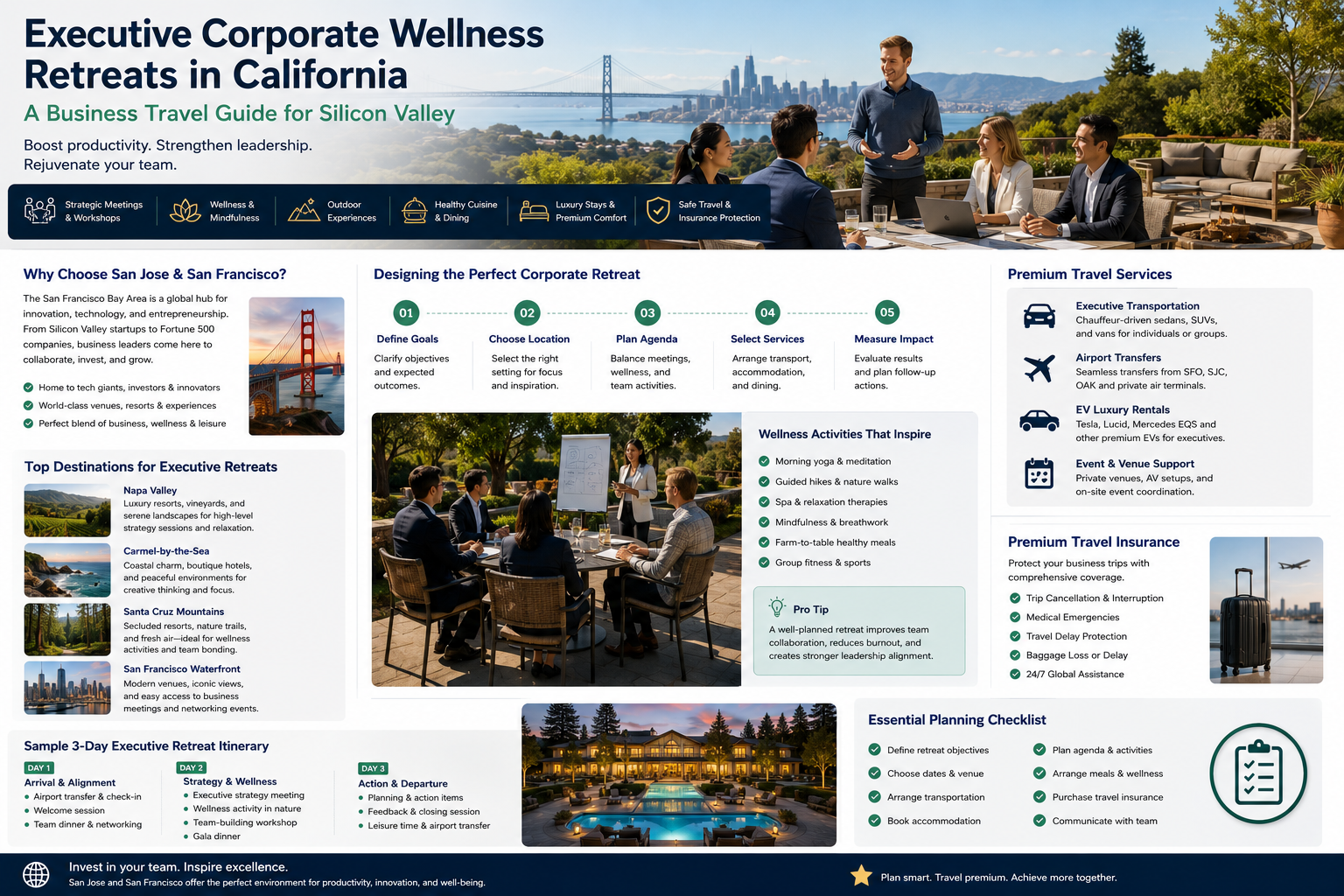
Creating a Three-Day Executive Retreat
A three-day schedule can provide enough time for business discussions without making the program excessively long.
Day One: Arrival and Connection
Participants arrive, transfer to the accommodation, and check in.
The evening can include a welcome reception or group dinner.
The objective is to allow participants to meet, settle in, and prepare for the main program.
Day Two: Strategy and Wellness
The second day can contain the primary business sessions.
A possible schedule:
8:00 AM: Breakfast
9:00 AM: Executive strategy session
11:00 AM: Break
11:30 AM: Leadership workshop
1:00 PM: Lunch
2:30 PM: Team planning session
4:30 PM: Wellness activity
7:00 PM: Group dinner
This format provides a mixture of focused work and relaxation.
Day Three: Action and Departure
The final day should focus on turning discussions into practical actions.
Participants can review:
- Key decisions
- Responsibilities
- Deadlines
- Business priorities
- Follow-up meetings
After the closing session, participants can have lunch and begin their departure arrangements.
How to Keep the Retreat Within Budget
A premium corporate retreat does not have to become an uncontrolled expense.
Companies can manage costs by planning the major components together.
Consider:
Accommodation
Compare group rates, meeting facilities, and included services rather than looking only at the room price.
Transportation
A single group vehicle may be more efficient than arranging separate rides.
Meals
Set a realistic food budget and identify which meals require formal dining.
Activities
Choose activities that support the retreat’s purpose rather than paying for expensive experiences simply because they are available.
Meeting Facilities
A hotel or venue that already includes suitable meeting facilities may reduce additional event costs.
Questions to Ask a Retreat Venue
Before making a booking, companies should ask:
- How many guests can the venue accommodate?
- Are private meeting rooms available?
- Is high-speed internet included?
- What presentation equipment is provided?
- Are catering services available?
- Can dietary requirements be accommodated?
- Is outdoor space available?
- Can transportation vehicles access the property?
- Are wellness services available?
- What cancellation policies apply?
Getting these answers in advance can prevent unexpected expenses and logistical problems.
Executive Retreat Planning Checklist
Use this checklist before confirming the trip:
Business Planning
- Define the retreat objective
- Determine the participant list
- Establish the budget
- Create the meeting agenda
- Assign responsibilities
Accommodation
- Compare suitable properties
- Confirm room availability
- Check meeting facilities
- Review internet and workspace options
- Confirm food and beverage services
Transportation
- Confirm arrival flights
- Arrange airport transfers
- Select appropriate vehicles
- Plan transportation between activities
- Allow extra time for traffic
Wellness
- Select appropriate activities
- Consider participant preferences
- Confirm activity requirements
- Prepare alternative plans for weather
Travel Protection
- Review existing corporate coverage
- Compare appropriate travel insurance
- Check medical coverage
- Review cancellation and interruption terms
How to Measure the Success of a Corporate Retreat
The retreat should not end when participants leave the venue.
Companies should determine whether the trip achieved its original goals.
For example, if the objective was strategic planning, the company should leave with a documented plan.
If the objective was leadership development, managers should identify specific actions to implement.
If the objective was team building, leaders can follow up with participants to understand what worked and what could be improved.
A short post-retreat survey can also provide useful feedback.
Final Thoughts
A Silicon Valley executive retreat can combine business, technology, wellness, and premium travel into one carefully planned experience.
The key is balance.
Executives need enough uninterrupted time to focus on important decisions, but they also benefit from comfortable accommodation, good food, outdoor experiences, and opportunities to recharge.
San Jose and San Francisco provide a wide range of possibilities for companies looking to create this type of experience. With the right planning, a corporate retreat can become more than a temporary change of scenery—it can provide a focused environment for strategic thinking, stronger professional relationships, and clearer business goals.
From executive transportation and premium EV rentals to luxury accommodation and premium travel insurance, each service should be selected according to the needs of the group.
The best retreat is one where participants return to work with greater clarity, stronger connections, and practical plans for the future.
executive corporate wellness retreats California, Silicon Valley corporate retreat, San Jose executive retreat, San Francisco corporate wellness retreat, premium EV luxury rentals Silicon Valley, corporate business travel California, executive transportation San Jose, luxury corporate retreats California, premium travel insurance California, Silicon Valley executive travel.